Sweepstakes Casino Operators Adjust to State-Level Restrictions Emerging in 2026
Jonas Lorenz · May 30, 2026

Sweepstakes Casino Operators Adjust to State-Level Restrictions Emerging in 2026
The US sweepstakes casino sector entered 2026 facing a shrinking state map due to new prohibitions, with California's Assembly Bill 831 taking effect on January 1, 2026 and eliminating an estimated one-fifth of national revenue, while Indiana's House Bill 1052 followed with an effective date of July 1, 2026. Operators have responded by exiting restricted states, developing new brands without dual-coin mechanics, adjusting marketing approaches, and modifying payment systems under ongoing regulatory and litigation pressures.
California Legislation Removes Significant Revenue Share
Assembly Bill 831 prohibited sweepstakes casino operations across California starting January 1, 2026, and analysts tracking the sector noted that this single state accounted for roughly 20 percent of total US sweepstakes casino revenue before the ban took hold. The measure closed access to platforms that had previously operated under sweepstakes models in the state, prompting immediate operational reviews among major providers. Data from industry tracking services showed a sharp drop in active user accounts originating from California addresses within the first quarter of the year.
Indiana Measure Adds Further Geographic Constraints
House Bill 1052 in Indiana set a July 1, 2026 implementation date for similar restrictions, extending the pattern of state-level prohibitions beyond the West Coast. This timeline allowed operators a brief window to wind down services in the state before full enforcement, and several platforms began notifying users of impending service changes in advance of the deadline. Combined with the California action, the two measures reduced the number of states where sweepstakes models could operate without direct conflict.
Operator Exits and Brand Development
Virtual Gaming Worlds, the parent company behind Chumba Casino and related platforms, initiated exits from both California and Indiana ahead of the respective effective dates. The company also introduced new brands that operate without dual-coin mechanics, including Just Slots, which launched as a single-currency alternative designed to align with emerging regulatory expectations. These moves reflect broader shifts where operators have separated promotional and paid elements to reduce exposure in jurisdictions tightening rules around sweepstakes formats.
Marketing and Payment Adaptations Under Scrutiny
Companies adjusted advertising strategies by focusing on states where operations remained permissible, while scaling back promotions in newly restricted areas. Payment rail modifications included greater emphasis on methods that comply with varying state requirements, and some platforms expanded testing of alternative processors to maintain transaction flow. Litigation involving sweepstakes models continued in multiple forums, adding pressure on operators to document compliance measures more rigorously than in prior years.
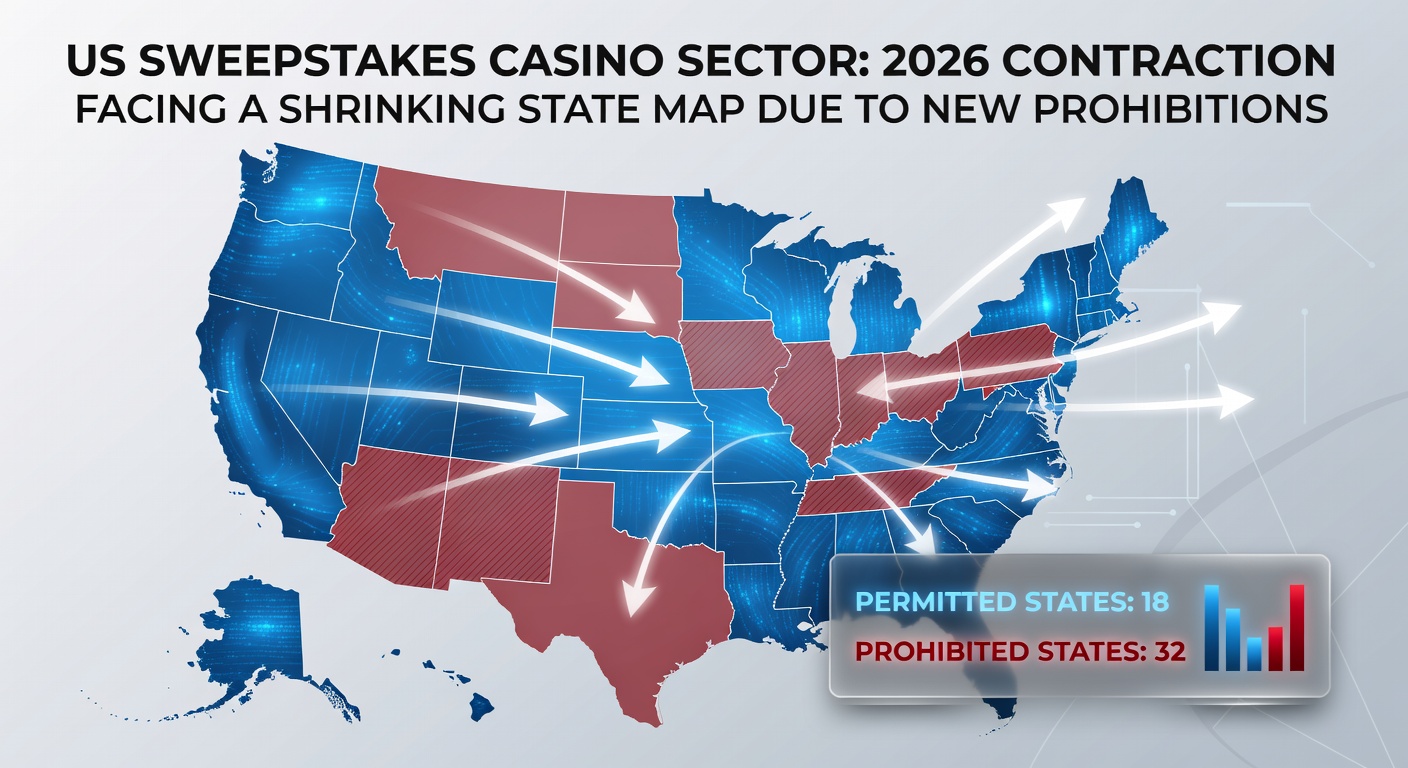
Observers tracking these developments noted that the combination of state prohibitions created a more fragmented market, where remaining operational states became higher priority for resource allocation. Figures released by sector analysts indicated that national revenue projections for 2026 were revised downward following the California implementation, with further adjustments expected once Indiana's restrictions took full effect.
Industry-Wide Patterns Emerging by Mid-2026
By May 2026, multiple operators had completed state exits and begun evaluating additional jurisdictions for potential future restrictions. Trade publications documented cases where platforms introduced verification enhancements and revised terms of service to address concerns raised in ongoing legal proceedings. Research reports from gaming policy organizations highlighted that sweepstakes models continued to generate activity in permitted states, though overall user acquisition costs rose as marketing channels narrowed.
Conclusion
The sequence of prohibitions in California and Indiana established a clearer boundary for sweepstakes casino operations entering 2026, and companies such as Virtual Gaming Worlds responded through geographic withdrawals, new brand creation without dual-coin structures, and targeted changes to marketing and payments. These adjustments occurred alongside sustained litigation activity, shaping the operational landscape for the remainder of the year.